List in order so nothing is missed, decide whether to add or multiply, take out anything counted twice, then use the counts to find a probability.
- 1Systematic Listing7:44
- Now playing: 2Addition and Multiplication Principles6:39
- 3Double Counting3:40
- 4Overlapping Groups6:30
- 5Probability9:40
Counting Principles: Addition and Multiplication Principles
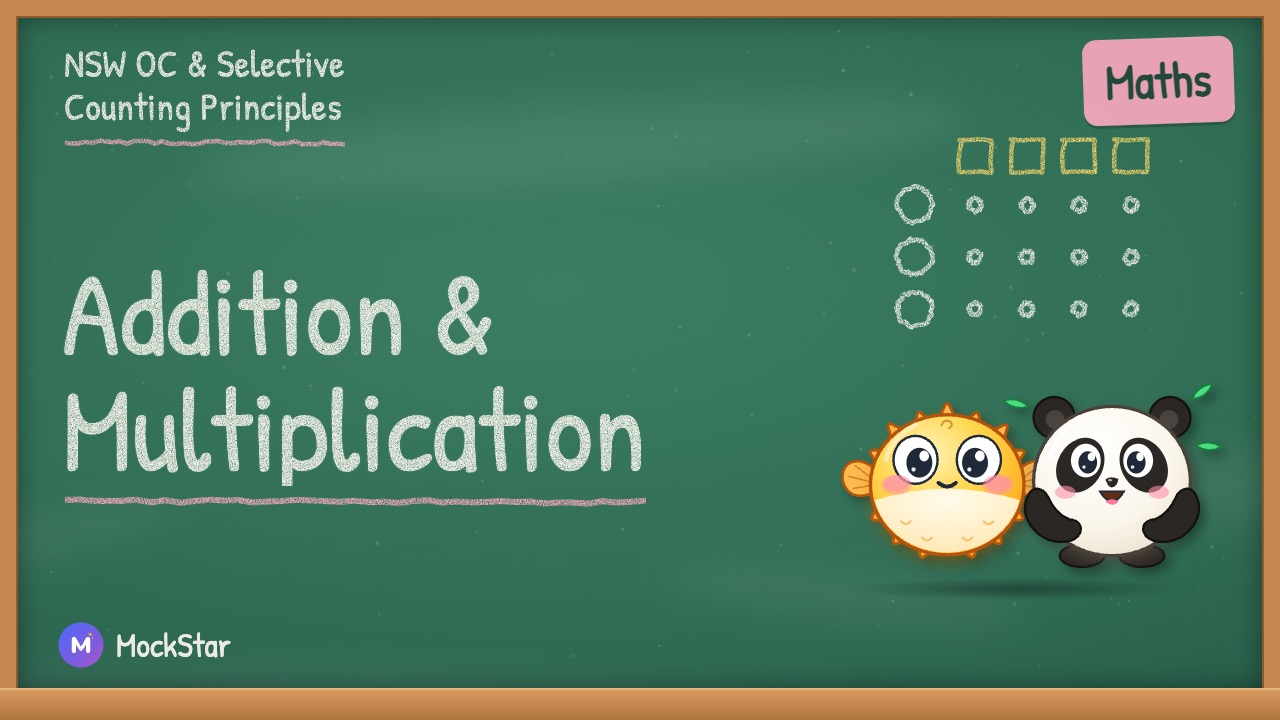
Methods in this video
Tap a time to jump to where the video teaches that method.
- 1
Number the crossings: add what points in
When to use it: The question shows a map where you can only travel in the direction of the arrows (one-way streets or a one-way grid) and asks how many different routes go from start to finish, with too many routes to trace one by one.
- Don't trace routes. At each crossing, write how many ways there are to get there from the start; the start gets 1.
- Each crossing = the sum of the numbers at the crossings whose arrows point into it. Find every incoming arrow first.
- Work along the arrows, one crossing at a time; the number at the finish is the answer.
- 2
Mix and match: one from each, so multiply
When to use it: The question has you choose one item from each of two (or more) different groups to make a set (trousers with a shirt, a flavour with a topping) and asks how many sets are possible, or who can make more.
- Choose one item, then another, one from each group, step after step, so multiply.
- Draw a grid: one row for each pair of trousers, one column for each shirt; the number of squares is the number of outfits.
- Watch out: adding counts the items, not the outfits (3 + 4 = 2 + 5, but 3 × 4 = 12 and 2 × 5 = 10).
Practise exam-style questions with these methods
Free 7-day trial, no credit card required.