Before reaching for a formula, move edges and split shapes to see what you really need.
- Now playing: 1Perimeter by Translation8:27
- 2Counting Cubes4:07
- 3Painted Cubes4:36
Geometric Reasoning: Perimeter by Translation
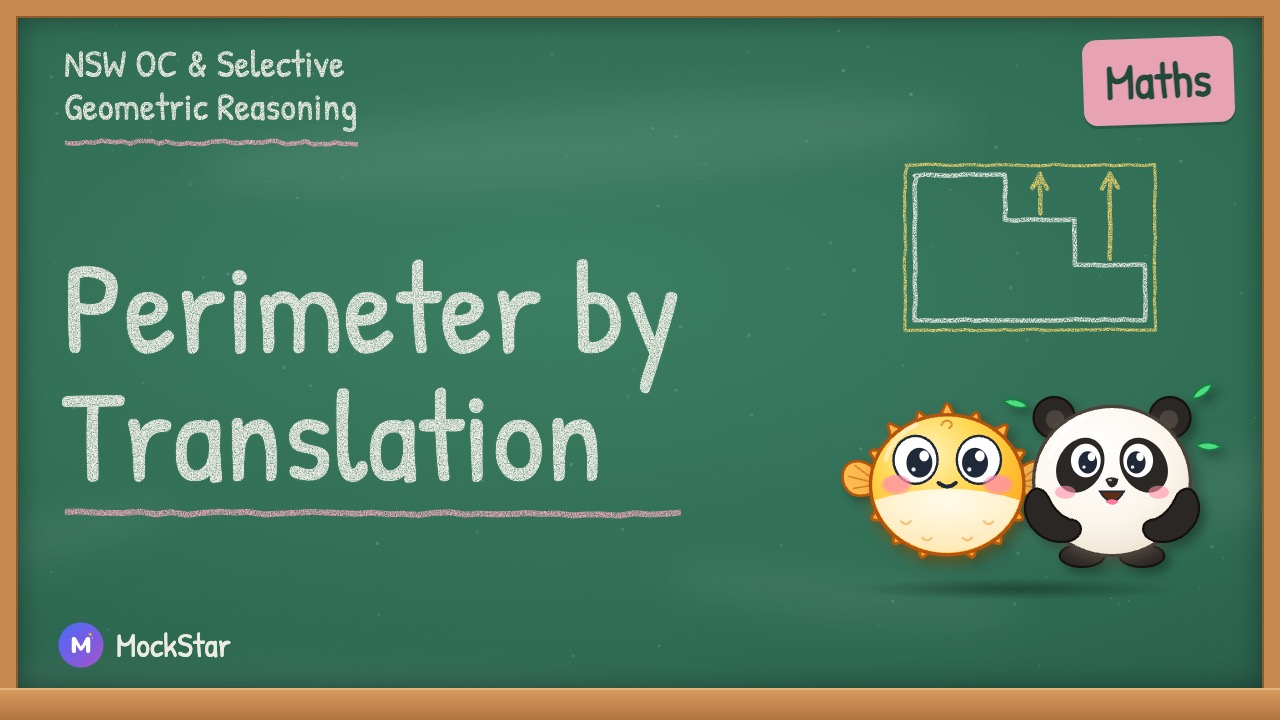
Methods in this video
Tap a time to jump to where the video teaches that method.
- 1
Parts of a line add up to the whole
When to use it: A shape made of rectangles or squares with some sides unlabelled and marked not to scale, asking for a length, or needing hidden lengths before a perimeter or area.
- Find one straight line and see which parts it is split into.
- The parts add up to the whole line, so the missing part is the whole minus the known parts.
- Check every corner: the width of the upright strip already takes up part of the line.
- 2
Push the sides to the frame
When to use it: Finding the perimeter of a stepped right-angled shape (a staircase, a rectangle with pieces cut out, a shape with a strip added) with many sides unlabelled.
- Push horizontal sides up or down and vertical sides left or right: the perimeter equals the frame's.
- A notch's two walls cannot be pushed out, so add them; a cut-off corner adds nothing.
- Same area does not mean same perimeter.
Practise exam-style questions with these methods
Free 7-day trial, no credit card required.