Drop the whole cycles, jump the whole units, and only count what is left over. When several things share the time, draw each as a bar, then see how the bars meet.
- Now playing: 1Repeating Patterns5:59
- 2Totals over Cycles5:12
- 3Calendars6:30
- 4Elapsed Time5:41
- 5Overlapping Time Periods3:55
- 6Time Spans4:11
Cycles and Time: Repeating Patterns
Methods in this video
Tap a time to jump to where the video teaches that method.
- 1
Where? Drop the full cycles, use the remainder
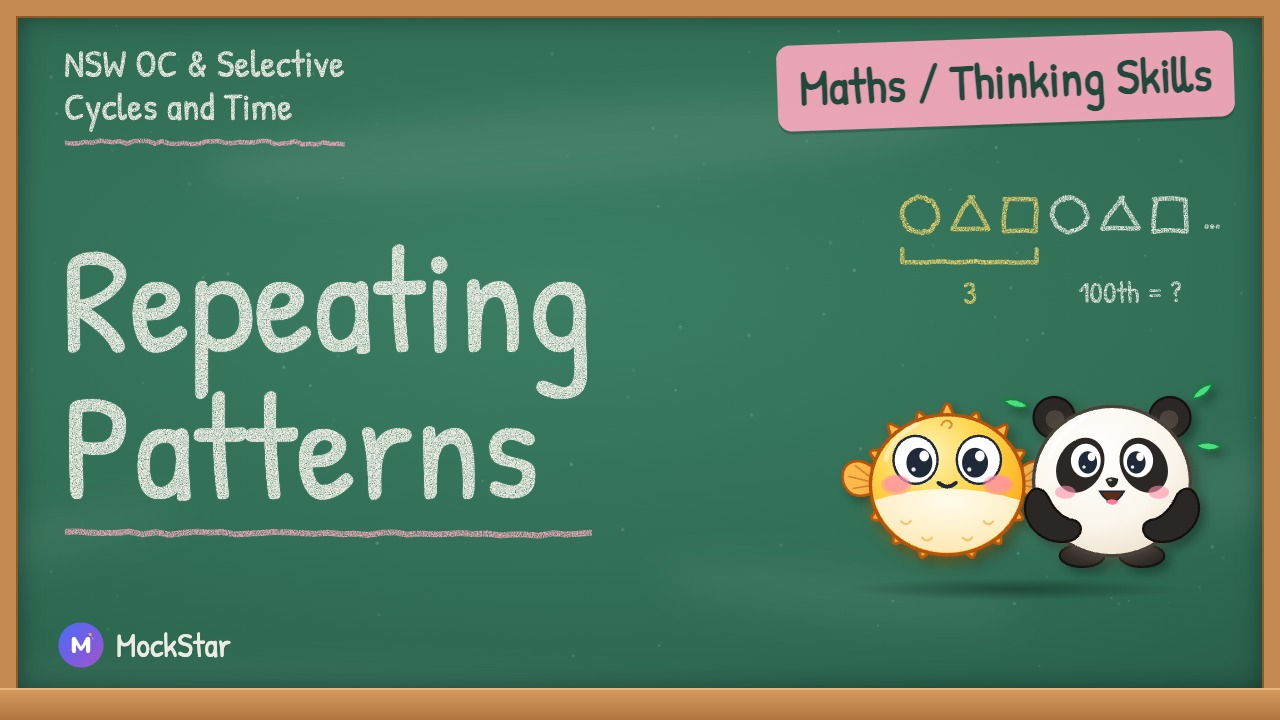
When to use it: A pattern, grid position, turn or pass keeps repeating, and the question asks what or where a far-off item is, or where something ends up after many moves. The cycle is not a week.
- Count one full cycle first: count the actual tiles, cells or moves, not the number of colours.
- Divide the position by the cycle length and ignore the quotient: remainder r means the r-th item in the cycle, and no remainder means the last item. For moves, no remainder means back at the start.
- Drop full cycles in each direction, then cancel. If only one coordinate cycles, work out the other one separately.
Practise exam-style questions with these methods
Free 7-day trial, no credit card required.