Split the whole into equal parts: find one part first, then scale up.
- 1Parts of a Whole9:24
- 2Comparing and Counting Fractions9:01
- Now playing: 3Area Fractions and Scale Factors9:31
- 4Pie Charts10:46
- 5The Unitary Method6:58
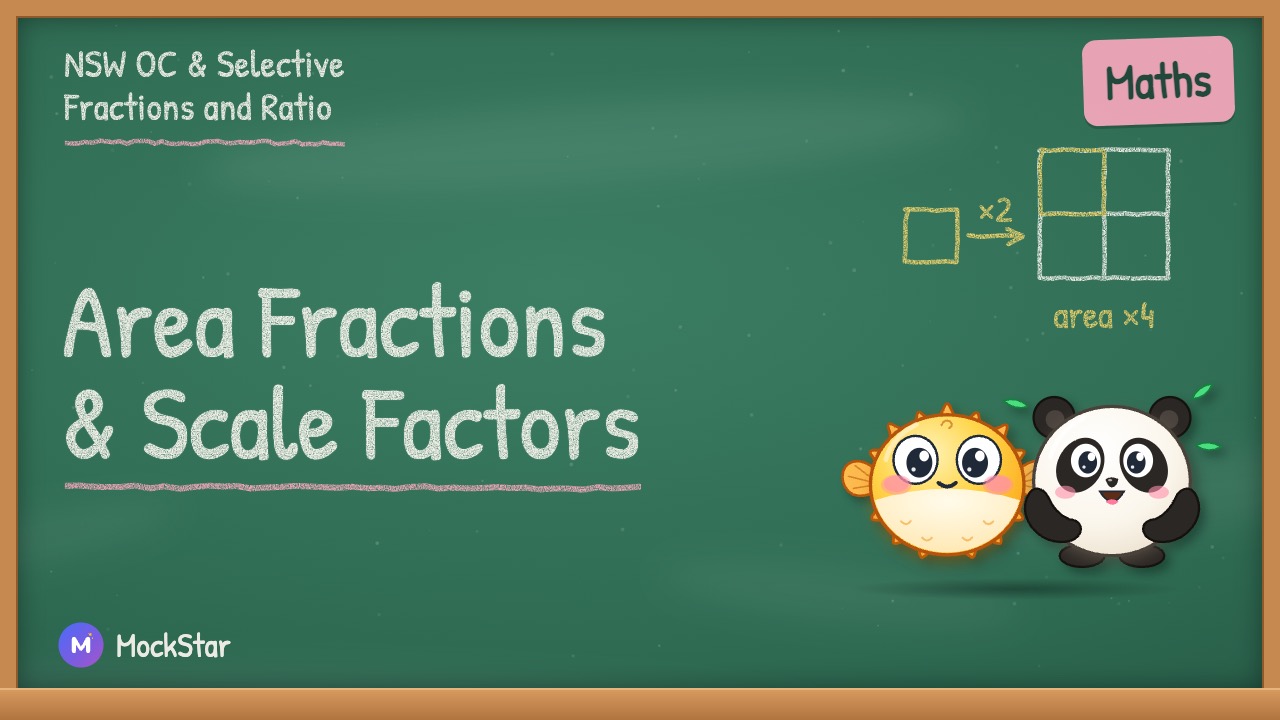
Fractions and Ratio: Area Fractions and Scale Factors
Methods in this video
Tap a time to jump to where the video teaches that method.
- 1
Equal pieces first, then count
When to use it: Find a shaded fraction, matching shaded fractions, extra shading or a shaded area. You need equal area parts, half cells, simple rearrangement or different ways of dividing the same whole.
- Name the whole shape. Count equal areas, not just the number of visible pieces.
- Split big pieces or move small pieces without gaps or overlaps. Subtract only the blanks from a frame. Keep half cells exact.
- Divide shaded parts by all parts. Match the area units across drawings, then subtract existing shading if asked for more.
- 2
Multiply for every direction
When to use it: A map scale, matching side lengths or changed cuboid dimensions are given. Find a perimeter, area, volume or the mass of a solid made from the same material.
- Match the sides and units. On a map, change each side to its real length first.
- For similar shapes, multiply perimeter by k and area by k squared. For volume, multiply the three direction factors.
- The factors may differ in each direction. Mass follows volume only for the same material at the same density.
Practise exam-style questions with these methods
Free 7-day trial, no credit card required.